
Leavenworth County VINE Coverage
The Leavenworth County Sheriff's Office expressly says that its jail sends booking and release data to VINE. Registered users can receive a custody-change notice by telephone, text, or email, and anyone can check supported custody status online. That direct local participation makes VINE a strong near-real-time channel for the county jail.
The boundary is just as important. Kansas Attorney General guidance says Kansas VINE covers adults in county jails, not KDOC state prisons. Lansing Correctional Facility therefore belongs in KASPER, even though it is in Leavenworth County. VINE also does not replace the BOP Inmate Locator, ICE locator, or Army Corrections Command. A “Leavenworth inmate” search must first identify the custodian.
VINE reports custody events. It does not supply the court judgment. The sheriff warns that Kansas courts do not send court dates or outcomes through VINE. A release alert may establish that the jail reported an exit, but not whether the person went home, transferred, or completed a case.
Search Leavenworth VINELink Records
Use the direct Kansas VINELink search. Search one person at a time and compare the available identity details. A common name can return more than one record, so the county, age, identifier, and custody location must fit before a status is attributed to anyone.
- Select Kansas and open the person search.
- Enter the exact name or offender identifier offered by the interface.
- Compare age or other identity details and select the Leavenworth County Jail record.
- Read the displayed custody status and location without strengthening the wording.
- Save the booking context if a notification or later record request may be needed.
- If no match appears, check spelling and then use the sheriff and court fallback.
A retrospective no-result is weak evidence. Display retention and matching can vary. The official sheriff Released tab, court docket, and focused jail-record request can preserve an older release episode. The Leavenworth County released inmate search path explains those channels.
The direct Kansas VINELink interface opens the state-specific search used for a Leavenworth County Jail record.
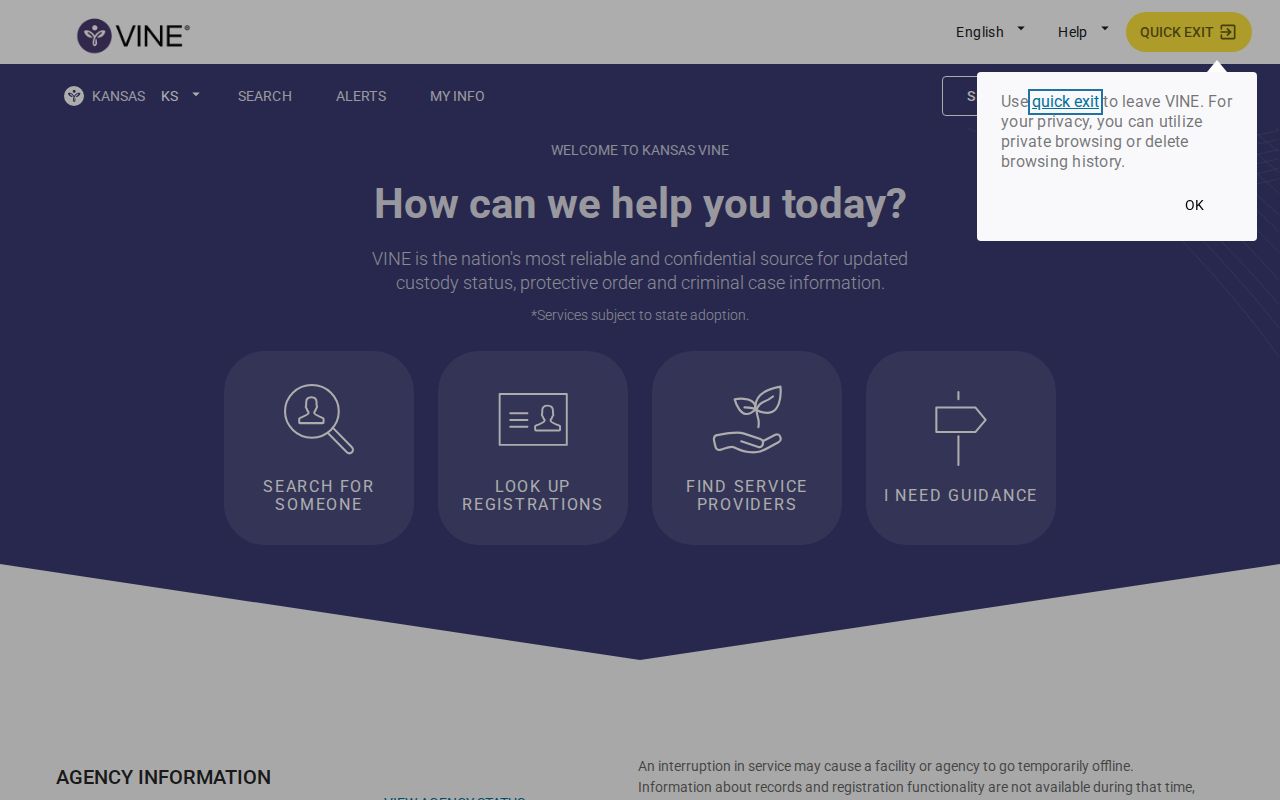
The state screen helps keep the search focused on a supported Kansas county-jail record rather than another custody system.
Leavenworth VINELink Release Fields
The exact display may vary by record and screen. Read only what appears. VINE data is useful for custody status and notification, while the sheriff record and court file answer the deeper release and case questions.
| Field or event | What it can establish |
|---|---|
| Name and identifier | The identity attached to the participating record |
| Custody status | The status currently reported by the jail feed |
| Facility or location | The reporting jail or shown custody location |
| Booking event | A reported admission to the Leavenworth County Jail |
| Release event | A reported exit from that county-jail custody episode |
| Transfer or escape event | A custody change that is not the same as final discharge |
A VINE release event does not reveal the release reason, destination, or court outcome. The sheriff Released profile also omits those facts. When the destination matters, ask for the existing custody/release entry and compare it with the court record.
Note: A VINE event is notification data from the jail, not a judgment, sentence-completion record, or statewide prison discharge.
Register Leavenworth Release Alerts
Registration works best while the person is still shown in Leavenworth County Jail custody. Open the correct record first. Then select notification and choose a supported contact method. VINE may report release, transfer, escape, or another custody change, so listen to the event wording rather than treating every message as freedom.
- Confirm the person's identity and Leavenworth County Jail record.
- Select registration or notification on that record.
- Choose telephone, text, email, or supported in-app delivery.
- For telephone calls, create a four-digit PIN.
- When a call arrives, listen and enter the PIN followed by the pound sign to acknowledge it.
- Preserve the timestamp and booking details, then confirm the event with the sheriff when needed.
Email registration does not use the telephone PIN. It sends an email when status changes. An unanswered call may be retried. The PIN is therefore not just an account password; it tells the automated service that the notice was received.
The sheriff lists 1-866-277-7477 and TTY 1-866-847-1298 for help. Because current state materials contain a phone-number discrepancy, use the numbers confirmed by the local sheriff source.
The national VINELink registration entry shows the state-selection route into notification registration.
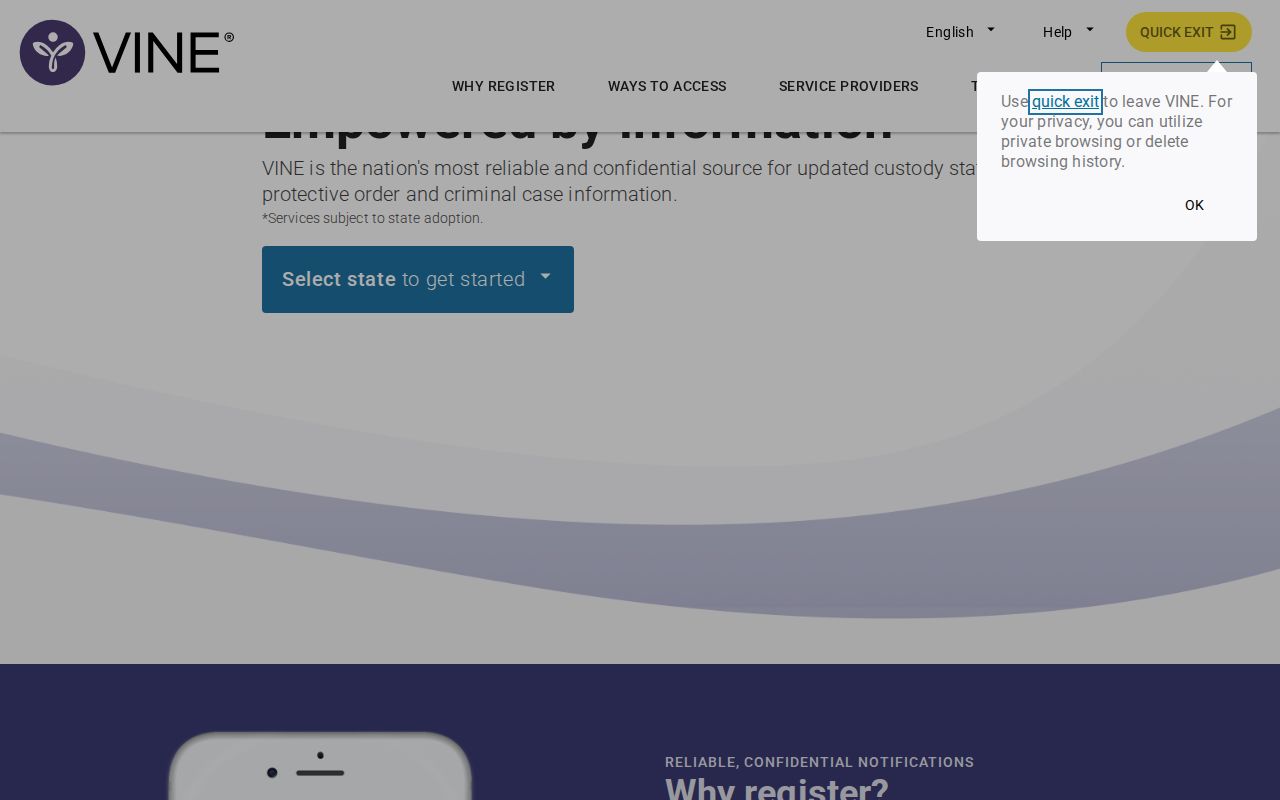
The registration view supports choosing the correct state and record before adding a phone, text, email, or app alert.
Leavenworth VINELink Search Limits
VINE is not a complete historical archive. A no-result after release may reflect retention, spelling, or matching rather than proof that no custody event occurred. Data can also lag the underlying event. For immediate status, call the Leavenworth County Sheriff's Office. For a durable record, request the existing booking and release entry.
If a county court sentence moved the person to KDOC, KASPER is the correct source. A federal conviction goes to BOP. ICE disappearance can mean release, transfer, removal, or a failed match. Military custody must be confirmed through Army Corrections Command. Never convert silence in one system into a claim about another.
When VINE sends a release alert, preserve its timestamp and booking identity. Describe it as a VINE-reported Leavenworth County Jail custody change. Then use the sheriff release record to determine whether the exit was to the community or another agency.
Leavenworth Jail Notification Layer
Leavenworth's VINE arrangement has an unusually clear local source. The sheriff confirms both booking and release transmission. That makes a timely alert strong evidence of a reported county-jail change, especially when the correct booking was registered in advance.
The same local FAQ draws a hard line around court information. Kansas courts do not participate in those notices. A bond order, dismissal, sentence, probation ruling, or case outcome must be read from the court record. The alert and docket answer different parts of the event.
State guidance draws the second line: county jails participate, KDOC does not. Lansing Correctional Facility sits nearby, but location does not expand VINE coverage. Search KASPER for a Lansing prisoner and VINE for the Leavenworth County Jail record.
The sheriff's VINE FAQ is the best local check on current participation and assistance details. Reconfirm there if the interface or contact method changes.
Registering before the expected event also preserves the strongest workflow. The user begins with a matched jail record, chooses a contact method, and later receives a notice tied to that record. Trying to reconstruct an old episode from a no-result lacks that link. For historical proof, the sheriff custody record and court docket are better sources.
Verify Leavenworth VINE Alerts
A delivered release alert is strong near-real-time evidence because the sheriff confirms that it supplies the source data. Preserve the timestamp and the booking identity in the notice. The careful claim is that VINE reported a Leavenworth County Jail custody change. The notice should not be restated as proof that the person went home, posted bond, completed a sentence, or had charges dismissed.
Compare the alert with the sheriff Released profile. That public profile can show the booking number and exact release time, plus booking details, charges, bond, and arresting agency. It does not show release cause, destination, or case outcome. A focused Kansas Open Records Act request can seek the existing release date, time, disposition, and receiving agency when those fields exist and are public.
The court record supplies another piece. A journal entry can explain bond, dismissal, sentencing, probation, revocation, or commitment to KDOC. Yet a court order can precede physical processing. The court establishes legal action; the sheriff record establishes when the county-jail episode ended.
When the alert says transfer or another custody change, follow the receiving agency. A KDOC commitment calls for KASPER. A pickup by another county requires that jail. A federal, ICE, or military transfer must be checked with the corresponding federal custodian.
No Leavenworth VINELink Result
A missing result does not prove release. First check spelling, aliases, and the identity details used in the search. Confirm that Kansas and the county-jail record were selected. A person may also be in a different Leavenworth custody system that VINE does not cover.
If the person recently disappeared from the current sheriff roster, inspect the official Released tab and call the sheriff's 24-hour non-emergency lines at 913-682-5724 or 913-682-1313. Ask whether the person remains at that facility. A telephone answer is useful for present status, while a written record request is stronger for historical proof.
Search the Leavenworth County court case next. The docket may show a bond change, dismissal, sentencing event, revocation, or KDOC commitment. If the court points to KDOC, use KASPER. If the name belongs to FCI Leavenworth, use the BOP Inmate Locator. ICE and Army custody have separate official routes.
VINE is designed for notification, not permanent archiving. An old record can stop appearing without changing what occurred. Ask for the existing booking and release entry with the approximate custody period and booking number when known.
Note: Search silence is ambiguous; match the custodian and obtain the record that documents the specific custody episode.
Leavenworth Release Alert Methods
Telephone, text, email, and supported in-app delivery serve different needs. Telephone calls require the four-digit PIN and pound sign to acknowledge receipt. Email does not require that PIN. An unanswered automated call may repeat, which helps explain why acknowledgment is part of the process.
Use contact details that the registrant can monitor and keep notification credentials private. The alert itself can contain sensitive custody information. If a phone number or email changes, update the registration through the official interface rather than assuming the old route will forward.
Notification is not the same as a scheduled release forecast. VINE can report a change after the jail transmits it. It does not calculate a KDOC Earliest Possible Release Date, provide a Kansas court outcome, or predict when a hold will clear. Its value is the event alert tied to the participating county-jail record.