
Leavenworth Projected Release Meaning
Kansas uses a careful label in KASPER: Earliest Possible Release Date. Both qualifying words matter. The field is a sentence-computation estimate, not an appointment at a gate. KDOC warns that board action and good-time or program credit can affect it. A public record may show no date because the sentence type, computation stage, or data limits do not support one.
Custody type changes the question. A pretrial detainee at Leavenworth County Jail usually has no sentence-based projected date. Release may depend on bond, dismissal, a court order, another hold, or later sentencing. A person serving a county sentence may have a calculable end, but the sheriff does not publish a county good-time formula. A KDOC prisoner is governed by state sentence computation. Federal, ICE, and military custody require their own custodians.
A parole hearing date is not a release date. Nor is a court order always the moment of physical exit. Processing and other agency holds can continue after legal authorization.
Find Leavenworth Release Dates
Start with the custodian. The KASPER offender search covers KDOC cases, including people held at Lansing Correctional Facility. It does not calculate dates for routine county-jail cases. For Leavenworth County Jail, use the sentencing journal entry, jail-credit order, and sheriff custody record.
- Identify whether custody is county, KDOC, BOP, ICE, or military.
- For KDOC, search by KDOC number when known and compare full identity details.
- Open the detail record and copy the exact status and Earliest Possible Release Date.
- For a county sentence, read the journal entry, jail credit, and later court orders.
- Ask the jail or court for the existing local computation instead of applying KDOC rates.
- Recheck the official record because credits, detainers, and orders can change.
KDOC updates KASPER each working day. A late Friday or holiday event may not appear at once. The Kansas district court records path explains the sentence, while the custodian confirms physical exit.
Leavenworth Release Credit Rules
For crimes committed on or after July 1, 1993, K.S.A. 21-6821 generally caps good time at 15 percent of the prison portion. The common “about 85 percent” phrase assumes the person qualifies for and keeps all available credit. It is not a universal release rule.
Enumerated lower-severity categories can have a 20 percent cap. The statute includes nondrug severity levels 7 through 10 for crimes on or after January 1, 2008 and specified drug levels for specified dates. Eligible inmates serving only listed severity categories may also earn up to 120 days of program credit for designated education, training, treatment, or risk-reduction work. Credit may be forfeited, and statutory limits govern eligibility.
Crimes before July 1, 1993 use a different table under K.S.A. 22-3725. K.S.A. 22-3717 separately governs parole eligibility and postrelease supervision. Older indeterminate, off-grid, and life cases require offense-specific review.
The Legislature's published K.S.A. 21-6821 text is the primary source for the Kansas good-time and program-credit limits.
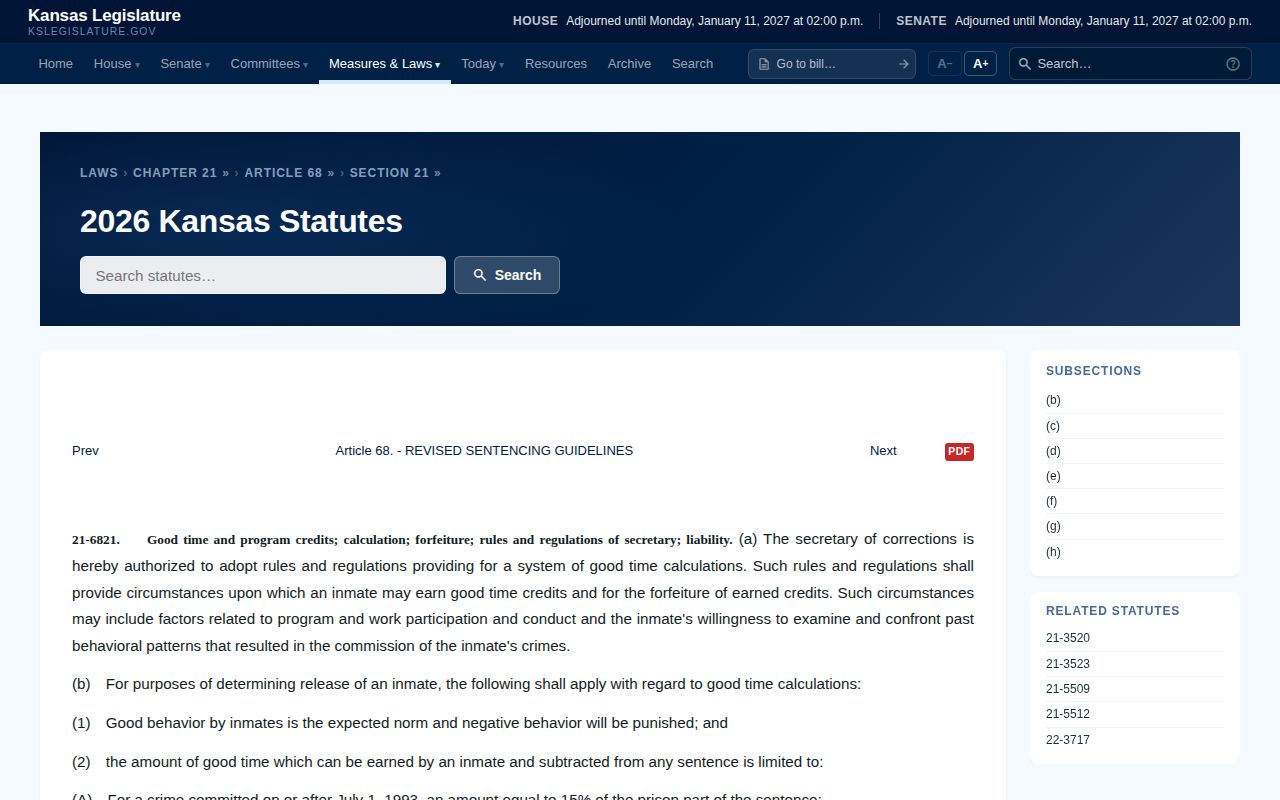
The statutory page shows why percentage caps must be treated as limits rather than automatic sentence reductions.
Note: Statutory credit caps are maximums, not automatic reductions, and the public KASPER computation is stronger than home arithmetic.
Why Leavenworth Release Dates Move
A projected date can move forward or back as the official sentence data changes. Quote the public field with its label and access date. One extra case, a credit decision, or a hold may change the result without changing the original conviction.
| Factor | Effect | Source |
|---|---|---|
| Good-time loss or restoration | Moves the earliest date | KDOC |
| Program credit | May reduce time within limits | KDOC |
| Consecutive cases | Changes how terms combine | Court and KDOC |
| Jail credit or amendment | Changes credited time | Court file |
| Detainer or hold | May prevent community release | Custodian |
| Board action | Affects parole-eligible cases | Prisoner Review Board |
A sheriff release time can mark transfer to KDOC instead of freedom. If the Leavenworth court imposed a KDOC sentence, search KASPER for admission and current location.
Confirm Leavenworth Actual Release
For KDOC, Current Status: Discharged with a Date Discharged is strong public evidence that the state sentence and supervision ended. Parole or postrelease status means the person left prison but remains supervised. Inmate means state custody continues even if the facility changed.
For the county jail, the sheriff Released profile shows when a booking episode ended, but not why or where the person went. Match the booking number and ask for the custody/release entry when destination matters. For advance county-jail alerts, use the Leavenworth VINELink inmate search. The released-inmate search and records path supports historical checks.
Federal BOP, ICE, and military dates come from their own custodians. Their systems cannot substitute for a county or KDOC release record.
Leavenworth Earliest Possible Release
KASPER's local importance is clear in a county that contains Lansing Correctional Facility. Still, its wording resists a promise. The date combines sentence information with applicable credit and board rules. It is stronger than a casual calculation, yet remains conditional.
The 15 percent cap is only the general category. Some lower-severity cases use 20 percent, eligible program work may subtract up to 120 days, and pre-1993 crimes follow another framework. Credit can be lost. Court amendments, consecutive cases, and detainers may also matter.
No sheriff source located in the Leavenworth research publishes a local good-time formula or weekend-release rule. A county sentence must be checked through its own court and jail records. Importing KDOC percentages into a jail calculation would create a false date.
A dated KASPER result should be recorded in conditional language: KASPER displayed an Earliest Possible Release Date when checked on that date. KDOC states that the field can be affected by board action and good-time or program credit. Recheck after a weekend, a known court amendment, or a credit change. Actual release still requires a later status or record.
Leavenworth County and KDOC Dates
Leavenworth County Jail and Lansing Correctional Facility sit in the same county, but they use different release-date paths. The jail holds pretrial detainees, people serving local sentences, people awaiting a KDOC bed, and people held for other agencies. Lansing is a KDOC prison. A sheriff release timestamp near a sentencing date may mark a transfer into KDOC custody rather than a return to the community.
Read the Leavenworth County court journal entry when the case moves from jail to prison. It may identify the sentence, jail credit, and commitment. Then search KASPER using the KDOC number when it is available. An admission or current-facility result shows that custody continued under the Secretary of Corrections. A later move away from Lansing is normally a prison transfer, not a release.
For a county sentence, the journal entry and jail-credit order are the reliable inputs. The sheriff's custody record establishes the physical exit. No official Leavenworth source in the research states that the county applies KDOC's percentage caps. Ask for the existing local computation or release entry. Do not ask staff to create a prediction that the office does not keep.
A pretrial case is different again. Bond, recognizance, dismissal, a court order, or another hold may control the next event. Since no prison sentence has been imposed, an Earliest Possible Release Date is not the right field. The court docket explains legal authority, while the jail confirms when the custody episode actually closes.
Leavenworth Parole Date Distinctions
Older indeterminate and some serious Kansas sentences can involve the Prisoner Review Board. A hearing month, public-comment date, or eligibility date does not promise release. The board may parole, continue, or pass a case, and release-plan requirements or another hold can delay physical exit even after favorable action.
K.S.A. 22-3717 governs parole eligibility and the postrelease framework. Guideline crimes after July 1, 1993 generally lead to mandatory postrelease supervision after the prison portion, while older, off-grid, and life structures demand closer review. The offense date and sentence type therefore matter as much as the displayed date.
The official K.S.A. 22-3717 publication provides the parole-eligibility and postrelease terms behind that distinction.
The statute confirms that eligibility, supervision, and actual physical release are related but separate events.
If a published hearing list contains a name, report only the hearing or potential eligibility information shown. After the hearing, check KASPER for a later status and ask the board about an outcome record. A hearing listing alone does not establish that a person left Lansing Correctional Facility.
Note: Parole eligibility marks when a decision may occur, while actual release requires the later custody record and status change.
Correct Leavenworth Release-Date Errors
KASPER's disclaimer directs comments and corrections to kdoc_pub@ks.gov. A useful correction identifies the KDOC number, the field believed to be wrong, the source supporting the correction, and safe contact information. The request should quote the public label exactly. Calling an Earliest Possible Release Date a guaranteed release date can create confusion before the agency even reviews the underlying data.
For a court-based error, compare the public docket with the journal entry or amended order. Internet access and document access are not identical, so a courthouse record may be needed. For a county-jail timestamp, ask the sheriff for the existing booking and custody/release entry. Each custodian should correct its own record.
Urgent present-status questions should not wait on a written correction alone. Contact KDOC or the supervising office as well. The public repository updates each working day, and a direct office confirmation may be newer after a weekend or holiday.
A correction request should not expose more personal data than the agency needs to locate the record. The KDOC number and precise field usually provide a stronger key than a broad name-only complaint. Keep the source document that supports the correction and note when the public result was viewed.
Leavenworth Release-Date Records
Different records answer different date questions. A KASPER Earliest Possible Release Date estimates the earliest state-prison exit under current computation. A KASPER Date Discharged documents the later end of KDOC control when paired with a discharged status. The sheriff release time closes a county-jail booking episode. A court order records legal authority but may not equal the moment of physical exit.
For a focused sheriff request, identify the full name, booking number when known, approximate booking period, and the existing fields sought. Ask for the recorded release date and time, release disposition or type, and receiving agency if that field exists and is public. Request electronic copies when practical. The sheriff says it will act within three business days, which can mean production, denial, or notice that more time is required.
For KDOC, use KASPER first. A discharge certificate can provide stronger proof of completed supervision when the public screen is not enough. Under K.S.A. 22-3722, the Prisoner Review Board may issue final discharge after satisfactory parole or conditional release and must issue a certificate at the end of postrelease supervision.
These documents should not be merged into one generic “release date.” State prison exit, county-jail exit, start of supervision, and final discharge may all occur on separate dates.