
Leavenworth Parole and Probation
Parole and probation both allow a person to live outside a jail or prison while following rules, but they begin in different ways. Kansas parole is tied chiefly to older indeterminate sentences and decisions by the Prisoner Review Board. Postrelease supervision follows the prison portion of many newer guideline sentences. Both state tracks are administered through Kansas Department of Corrections Parole Services. Probation starts with a court order. In Leavenworth County, First Judicial District Court Services and Leavenworth County Community Corrections handle court-centered supervision, while a city court may retain a municipal case.
The right source follows the sentence, not the person's street address. Someone released from Lansing Correctional Facility may report to the Lansing Parole Office. A person sentenced to county probation may instead report to Community Corrections or Court Services. A blank state search therefore cannot rule out probation.
| Track | How it begins | Best verification source |
|---|---|---|
| Parole | Release under an older parole-eligible state sentence | KASPER, Prisoner Review Board, Parole Services |
| Postrelease supervision | Required supervision after a Kansas prison term | KASPER and the assigned parole office |
| District-court probation | Order in a criminal case instead of, or after suspension of, confinement | Court docket and the agency named in the order |
| Community Corrections | Local supervision for eligible court cases | Leavenworth County Community Corrections and court record |
- Discharge
- The formal end of supervision, not merely release from a cell.
- Absconder
- A supervision status alleging loss of required contact. It is not discharge.
- Detainer
- A request or hold that may keep custody in place for another authority.
Verify Leavenworth Post-Release Supervision
Begin by deciding whether the case was a Kansas prison sentence or a county court matter. The KASPER offender search covers KDOC custody and supervision, but not every county-jail stay. The Kansas court record is the stronger start for probation. Use exact identity details and never treat a name match alone as proof.
- Identify the sentencing authority. Read the Leavenworth County court docket or sentencing order. A KDOC commitment points to KASPER; probation language points to the named local agency.
- Search KASPER carefully. A KDOC number is the safest key. With a name search, compare birth information, conviction, photograph, and case details.
- Read the precise status. Parole or postrelease status means the person is outside prison but still supervised. Community Corrections is not final discharge.
- Check the local gap. KASPER warns that Community Corrections probation events after April 21, 2021 may not display. Confirm through the docket and local office.
- Confirm the assigned office. Use the official KDOC office directory or the agency named in the court order before visiting.
- Document final discharge separately. A Date Discharged in KASPER or a formal discharge certificate is stronger than assuming supervision ended.
A state record can show conviction county, parole supervision county, current facility, and Community Corrections location. Those fields answer different questions. For a broader release-record path, use the Leavenworth County released inmate search.
The official KASPER parole absconder lookup provides the state search entry for this specific supervision status.
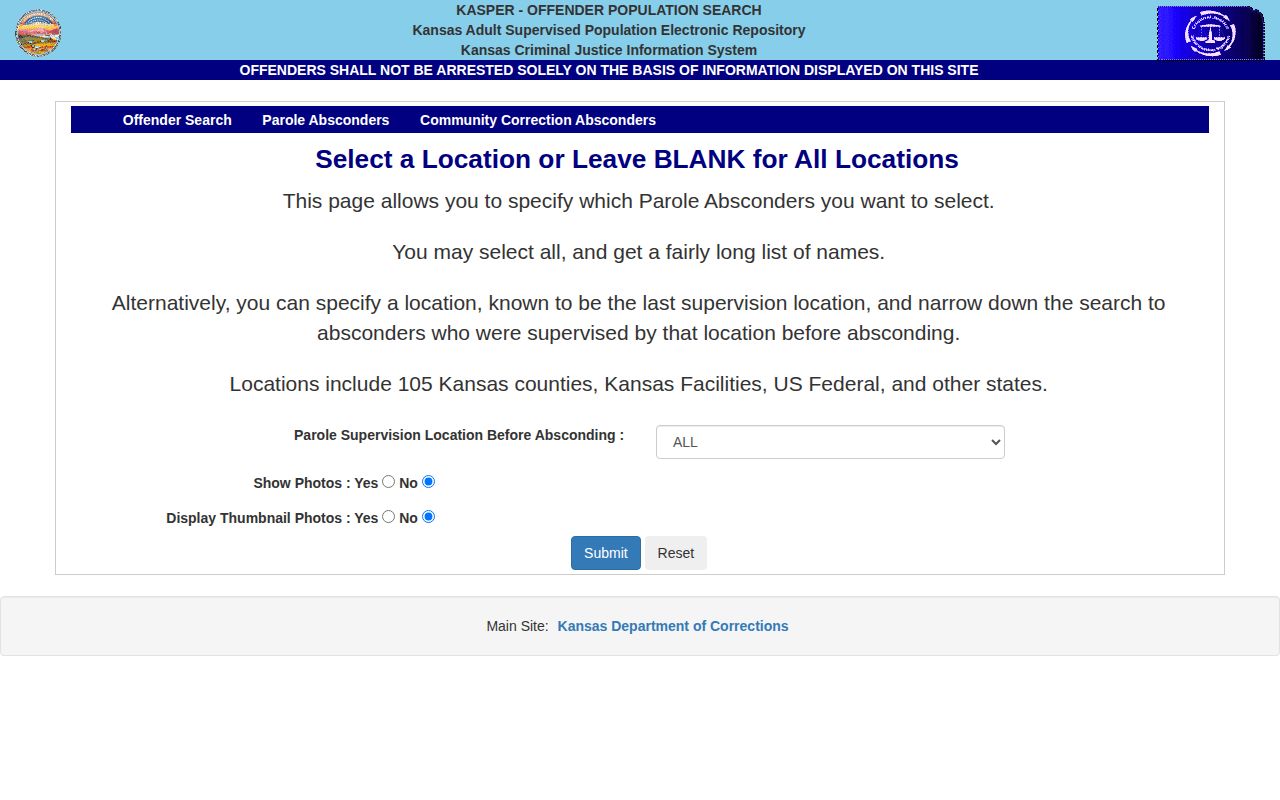
The search screen reinforces that an absconder result belongs to the state supervision system and should be confirmed with Parole Services.
Leavenworth State Supervision Office
The official KDOC directory assigns Leavenworth County to the North Region's Lansing Parole Office. The county's 2024 mapping report independently says this office supervises Leavenworth residents released from state facilities and applicable interstate-compact cases. It does not replace Court Services or Community Corrections for a local probation order.
Lansing Parole Office
301 E. Kansas Ave.
P.O. Box 194
Lansing, KS 66043
Phone: 913-250-2633
Confirm the office listing and access instructions before arrival.
The street address is also associated with the Lansing correctional campus. That makes advance confirmation useful. Ask the office whether it supervises the named case and what public verification it can provide. Do not assume the facility entrance and parole-office entrance are the same.
The KDOC parole office directory identifies the Lansing office that serves Leavenworth County.
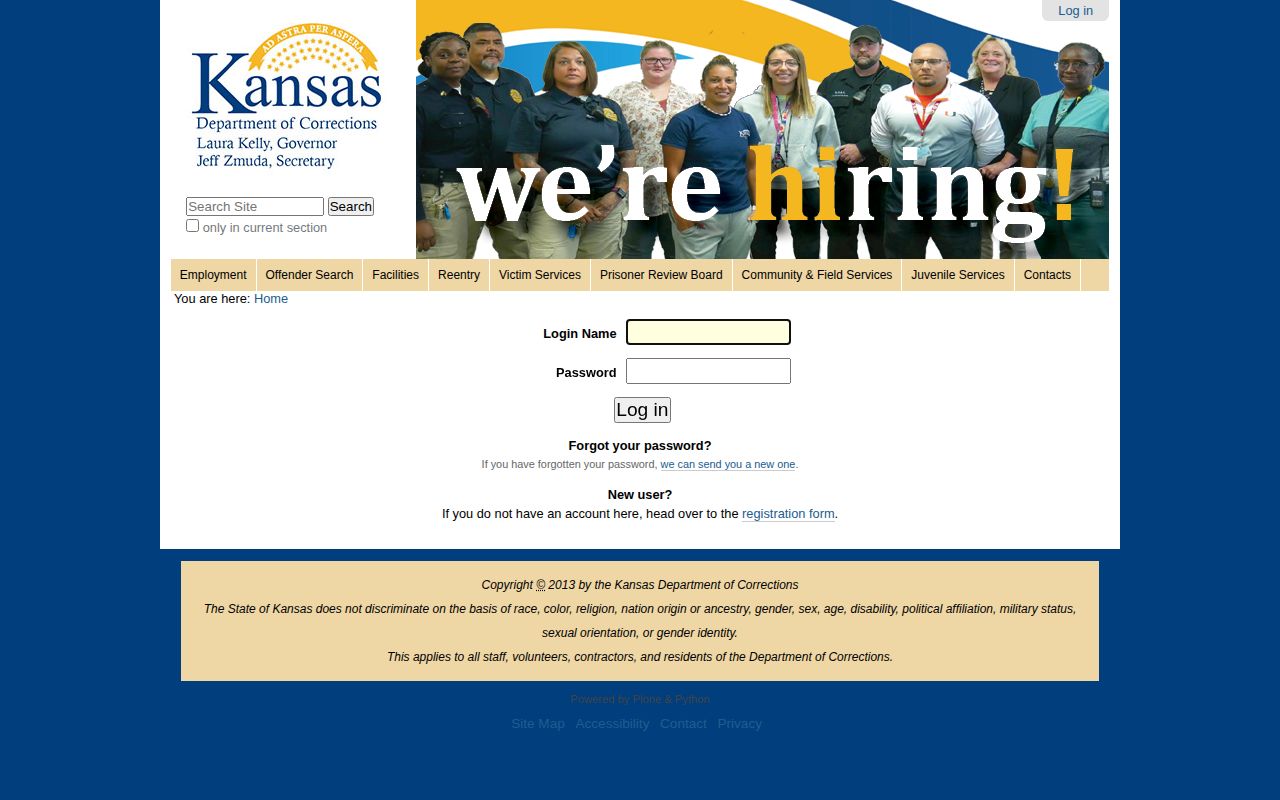
The published directory supplies the office-specific address and phone used in the contact card above.
Note: The state office serves parole and postrelease cases; the sentencing order identifies the right office for county probation.
Leavenworth Supervision Status Changes
Conditions are the rules attached to supervision. The exact terms belong to the order and agency record. Common supervision work can include required contact, approved residence, treatment, payment, travel limits, and compliance with laws, but no single public summary proves the terms in one Leavenworth County case. A violation allegation may lead to closer supervision, a court proceeding, a board action, or custody. It does not automatically mean that the original sentence has ended.
KASPER offers a dedicated parole absconder search. An absconder result means the agency alleges that required contact or compliance stopped. It is not a discharge record. It also is not an instruction for a member of the public to confront or detain anyone. Record the exact status, last supervision location, and access date, then use the supervising office for current confirmation. A person can be out of prison and still face a supervision warrant or hold.
VINE is different. Leavenworth County Jail reports booking and release events to VINE, but Kansas VINE does not cover KDOC prison supervision or court outcomes. It can confirm a new jail custody event, not the full legal result of a parole or probation case.
Leavenworth Supervision and Discharge
Physical release, supervision, and discharge are three distinct points. A person may leave Lansing Correctional Facility and enter parole or mandatory postrelease supervision. The sentence remains active while that supervision continues. KASPER may later show Current Status: Discharged and a Date Discharged. That pair is the strongest public state indicator that the KDOC sentence and supervision relationship ended.
K.S.A. 22-3722 provides a documentary route. The Prisoner Review Board may issue final discharge after satisfactory parole or conditional release and must issue a certificate at the end of postrelease supervision. When proof beyond a public screen is needed, ask KDOC or the board about the discharge certificate or underlying record. For probation, look for the court's discharge or termination order. A jail release time alone cannot supply that answer.
Records may be sealed, expunged, redacted, or unavailable under Kansas law. Public offices need not create a new explanation. A focused request should name the existing status, order, certificate, or date field sought.
Note: A Leavenworth County jail release proves an exit from that booking episode, not the end of state or court supervision.
Which Leavenworth Parole Office?
The Lansing Parole Office detail matters because Leavenworth County contains both a state prison and the office serving released state cases. The shared street address can cause confusion. The KDOC contact directory gives the parole office its own telephone number, while the county mapping report confirms its role in local supervision. Call the parole office number, state that the question concerns supervision rather than prison visitation, and confirm the entrance or appointment process.
Interstate-compact cases may also be managed through this office when Kansas supervises an eligible person from another state. That still does not turn every Leavenworth resident into a Lansing office case. The sending state, receiving state, sentencing court, and formal transfer of supervision control the route. The office or case order provides the answer.
This local distinction prevents a common error: contacting the county jail about a KDOC parole issue. The jail can confirm its own custody episode. Parole Services controls state supervision, while the First Judicial District and local Community Corrections handle their own probation tracks.
The distinction also affects what a public record can prove. A KASPER parole status establishes a state supervision status when checked, but it does not reveal every condition or every recent contact with the officer. A district-court docket can establish that probation was ordered, revoked, extended, or terminated, but a docket entry may not show all day-to-day supervision details. The most defensible verification pairs the public status with the office responsible for the case.
Leavenworth County residents released from a state facility may also be supervised through an interstate compact when another state is involved. The county mapping report says the Lansing office manages applicable compact cases. That fact does not establish which state currently directs a specific case. Confirm the assigned officer and receiving state through the official office rather than inferring jurisdiction from an address.
Final discharge deserves the same care. A person can finish the prison portion, leave the facility, comply with supervision, and later receive a discharge record. Each event has its own date. KASPER, the Prisoner Review Board, and the sentencing court preserve different parts of that sequence. Keeping those dates separate avoids turning a release from a building into a claim that all legal control ended.
KASPER also distinguishes conviction county, parole supervision county, Community Corrections location, and current facility. A Leavenworth conviction does not prove that the person reports to a Leavenworth office now. Likewise, a Leavenworth supervision location does not prove that the conviction arose there. Read the label attached to each field and confirm the assignment with the office directory.
When a public state record seems wrong, KASPER directs written corrections to its published contact. Identify the KDOC number, disputed field, and supporting source. For local probation, take a docket discrepancy to the court or supervising agency named in the order. Each office controls its own record, and one system should not be used to overwrite another.
Note: Match the supervision type, assigned county, and responsible office before treating a public status as current Leavenworth supervision.