
Leavenworth County Three-Day Releases
The official sheriff Released tab is the only county feed found for recent jail exits. It is not labeled as a 72-hour view. No separate sheriff URL promises three days of results. The page sorts by release time in descending order, which still makes it useful for building a manual three-day check.
Begin with a precise cutoff. If checking at 4 p.m. Monday, the rolling period starts at 4 p.m. Friday, not at midnight Friday. Record the access time and compare every displayed timestamp. The method is especially helpful when a same-day scan missed Friday-night, Saturday, or Sunday activity. Yet the public list can stop before the cutoff. Research in July 2026 observed about 35 hours, not 72.
The sheriff Released view shown below is the source to inspect.
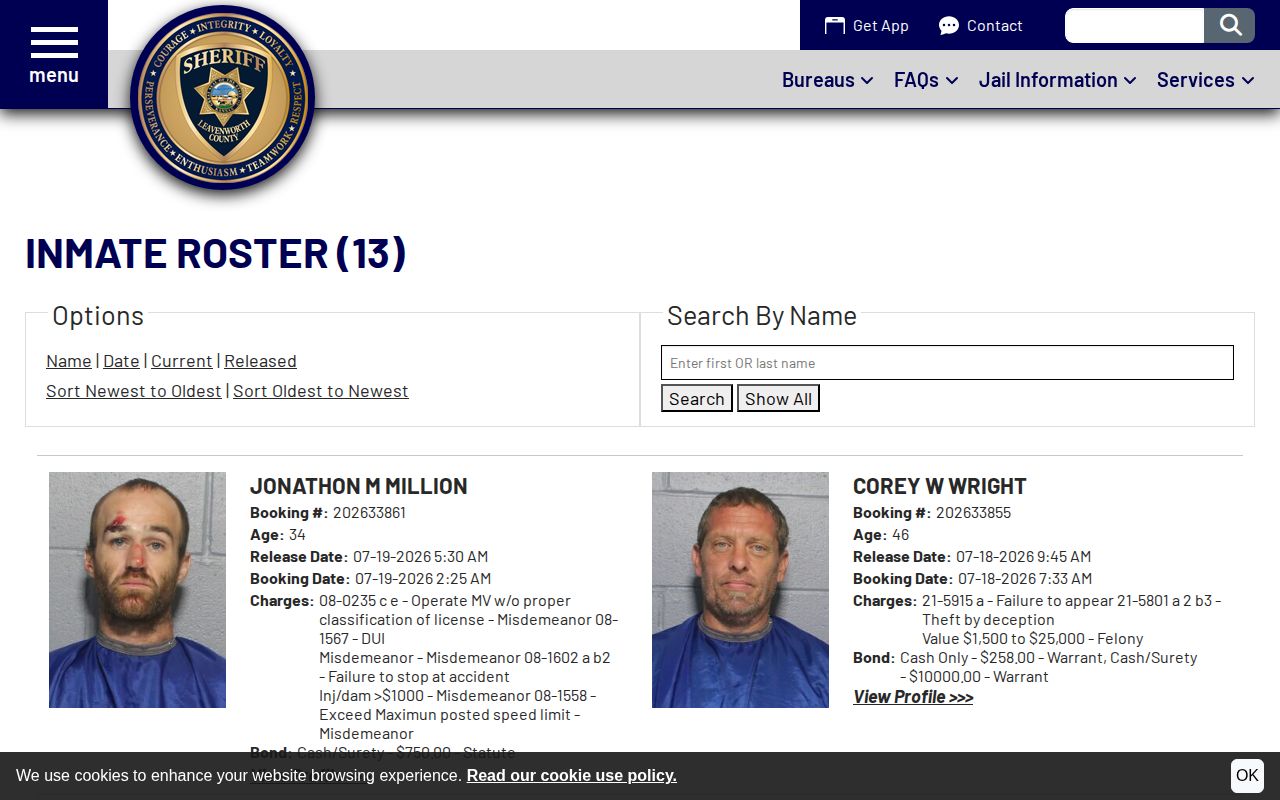
Its precise timestamps permit a manual cutoff, while the unlabeled span requires an independent fallback for the missing part of a three-day period.
Build a Leavenworth 72-Hour Check
The sheriff’s roster search has Current and Released controls. Use Released for closed jail episodes, then work backward from the newest time. A calendar range is only the first pass. The complete check adds sources that do not depend on the short public display.
- Write down the exact current date and time, then calculate the point 72 hours earlier.
- Open the Released tab and confirm that results are sorted with the newest release first.
- Review entries until the list reaches the cutoff or ends. Note any gap before the cutoff.
- Match names with age, photograph, booking time, and booking number rather than relying on name alone.
- Search the individual name because a broad display may not include an older entry that remains searchable.
- Use VINE, the court record, and a sheriff request to fill any unshown part of the period.
For a one-person inquiry, the Leavenworth County released inmate search path can be faster. It starts by identifying whether the person belonged to the county jail, KDOC, BOP, Army, or ICE, then points to that custodian’s source.
Leavenworth Three-Day Record Fields
The Released tab’s fields establish identity and timing for the displayed county booking. They do not provide a three-day flag. The reader supplies the date calculation. They also do not state where the person went.
| Displayed field | Use in a 72-hour review |
|---|---|
| Name and photograph | Match the person to the booking shown by the sheriff. |
| Booking number | Separate that episode from prior or later bookings and identify a records request. |
| Release date and time | Compare against the exact rolling three-day cutoff. |
| Booking date and time | Place the start of the local custody episode. |
| Age, gender, and race | Use as identity checks when names are alike. |
| Charges and bond | Read as booking data, not as proof of disposition or release reason. |
| Arresting agency | Identify the agency connected with the arrest, not necessarily the destination. |
Reason, destination, and court outcome were not visible fields. If a released profile lists extradition, a parole violation, transport, or a hold, the exit may be to another jail or agency. A release timestamp confirms that the Leavenworth County Jail episode closed. It cannot, by itself, confirm community freedom.
Leavenworth Weekend Release Timing
A three-day review often crosses a weekend. That can bring court and record timing into the result. The county mapping report says an initial appearance generally occurs within 48 hours but may take longer after Friday or evening weekend booking. That statement describes the first court process. It is not a promise about when the sheriff will publish a release entry.
Saturday and Sunday jail operations continue, while some court and administrative channels work on a weekday schedule. A person may leave after a judge’s order, bond transaction, sentence completion, or agency pickup. The public entry can appear after processing. Another person may remain held because of a separate warrant or detainer even after one case allows release. A detainer is authority that keeps custody in place for another matter or agency.
KASPER introduces a different timing issue. KDOC says that system updates each working day, so a late Friday state transfer may not appear at once. Do not apply KASPER’s cadence to the sheriff feed. The systems have separate custodians and rules.
Note: Keep the access timestamp with any weekend result because the sheriff publishes no update schedule for its Released display.
Leavenworth Released Tab Gaps
Leavenworth’s public data has an uncommon strength: a genuine Released tab with photographs and exact release times. The same source has a clear limit. It gives no cadence, retention statement, or promised number of entries. The July 2026 observation of 19 records over about 35 hours was a snapshot. Future volume or site settings can change the span.
When the list ends before the calculated cutoff, mark the remaining period as unverified. Do not assume no releases occurred. Search the person’s name, use VINE, and inspect the district court case. The court can show a bond order, dismissal, sentence, probation event, or commitment. Only the custodian record establishes physical exit time.
The Jail Releases: 24 Hours method focuses on today’s newest entries and immediate verification. The three-day method focuses instead on coverage gaps, weekend handoffs, and older events that may already have left the broad feed.
Find Missing Leavenworth Releases
A person who disappeared from Current but is absent from Released has not been proven released. Check spelling, aliases, and booking dates. Then use the sheriff’s VINE guidance. The sheriff states that it sends county-jail booking and release events to VINE. A delivered alert is strong evidence of a custody change, though it does not give the court outcome.
Call the jail’s 24-hour non-emergency lines at 913-682-5724 or 913-682-1313 for present local status. Ask whether the person remains in that facility and whether any departure was to a named agency. For historical proof, use the open-records request form. Give the full name, approximate custody interval, and booking number if known. Request the existing release-log entry, date and time, disposition or type, and receiving agency if releasable.
The sheriff must act on a Kansas open-records request by the end of the third business day, but final production can take longer. The office can estimate reasonable costs and require advance payment. Records may also be destroyed under an applicable retention schedule. The online feed’s duration is not that schedule.
Route Leavenworth Release Records
The county’s correctional landscape makes a three-day name scan easy to misread. The Leavenworth County Jail Released tab belongs only to the sheriff’s jail. Lansing Correctional Facility releases are state matters found through KASPER and KDOC. FCI Leavenworth releases use the BOP locator. The two Fort Leavenworth military facilities require Army channels, while the Midwest Regional Reception Center uses ICE custody sources.
| Custody episode | Correct follow-up |
|---|---|
| Leavenworth County Jail | Sheriff Released tab, VINE, phone, court, and sheriff record. |
| Kansas state prison | KASPER status and release-related dates; KDOC Parole Services if supervised. |
| Federal BOP | BOP locator release date and Released or not-in-BOP-custody result. |
| Military confinement | Army Corrections Command or the facility’s formal records route. |
| ICE detention | ICE locator and Enforcement and Removal Operations confirmation. |
A transfer is not release to the community. Discharge is also different from physical release: it means the responsible corrections system has ended its sentence or supervision relationship. Keep those terms tied to the field and agency that used them.
Use KASPER only after a court or jail record points to Kansas corrections. It does not document an ordinary county bond exit. Likewise, a BOP result does not cover an Army prisoner merely because both facilities sit in Leavenworth County. If the original custodian cannot confirm the destination, ask for the existing transfer or release disposition rather than guessing from a missing name. The three-day period is a useful search frame, but the agency record remains the source of the claim.
For a person subject to registration after release, the KBI or sheriff registry can remain public long after the jail event. That entry proves a registration duty, not a fresh release. A VINE event is closer to the county custody change, while the court record explains the legal step. Keeping these sources separate prevents an older public entry from being mistaken for weekend jail activity.