
Lansing Prison Release Paths
Lansing Correctional Facility is operated by the Kansas Department of Corrections. It is not an annex of Leavenworth County Jail. The state prison holds sentenced adults in maximum, medium, and minimum units, while the county jail serves a broad mix of pretrial, short-sentence, warrant, hold, and transfer cases. That difference controls where a release record lives.
A Lansing release can mean the person left the prison to serve a period of postrelease supervision, entered parole under an applicable sentence, or reached another authorized status outside the institution. “Paroled” and “postrelease” both mean the person is outside prison but remains under legal supervision. “Discharged” is different. It is KDOC's public signal that the sentence and supervision relationship has ended. A move from Lansing to another KDOC facility remains state custody and should be described as a transfer.
| KDOC result | Meaning for a Lansing inquiry |
|---|---|
| Inmate | Still in KDOC custody, even if the location is no longer Lansing |
| Parole or supervision | Outside prison under state supervision |
| Community Corrections | Community supervision, not final discharge |
| Discharged with date | KDOC records completion of its sentence and supervision relationship |
| Deceased or Discharged-Deceased | Not a community release |
Confirm Lansing Facility Releases
Search the Kansas Adult Supervised Population Electronic Repository, known as KASPER. Accept the disclaimer and complete the access check. A KDOC number is the strongest key. Name searches support last, first, and middle name, aliases, and several advanced fields. When names are common, compare age or birth information, race, conviction, case information, and photograph before selecting a record.
- Search by KDOC number when it is known; otherwise use full name and aliases.
- Open the detail record and record its exact Current Status, current location, admission data, convictions, and date labels.
- Separate a facility move from a release. A new KDOC location means custody continued.
- If the record shows parole or post-incarceration supervision, confirm the serving office through KDOC Parole Services.
- For final completion, look for Discharged and Date Discharged or request the applicable discharge certificate.
The statewide record is the correct path even though Lansing sits in Leavenworth County. The sheriff's Released tab documents county-jail episodes and cannot certify a KDOC prison release. The broader Leavenworth County release search explains how to switch systems when a person first moved from the county jail into state custody.
Lansing KASPER Search Fields
KASPER offers unusually detailed filters. Along with name and KDOC number, advanced inputs include KBI state identification, race, gender, birth date or age range, conviction county, parole-supervision county, Community Corrections supervision location, current facility, and supervision type. These fields answer different questions. A Leavenworth conviction, supervision address, and prison location must not be treated as the same geographic fact.
| Field | How it helps |
|---|---|
| KDOC number | Best public identifier for matching the state record |
| Current Status | Distinguishes inmate, parole, community supervision, absconder, and discharge |
| Current facility | Shows whether a person remains at Lansing or moved within KDOC |
| Earliest Possible Release Date | Projection that may change, not a completed release |
| Date Discharged | Strong public evidence that KDOC control ended |
The KASPER search form illustrates the state search route and its identity filters.
The search is statewide. It should not be narrowed to Leavenworth County unless the known facts truly call for a county-specific field.
Lansing Projected Release Record
The exact public label documented in KASPER material is “Earliest Possible Release Date.” That is a projected field. It can be affected by a Prisoner Review Board action and by good-time or program credit. Some records may omit it due to sentence type, calculation stage, or data limits. Do not silently turn that field into a scheduled appointment or guaranteed exit.
Kansas sentences do not all follow one release structure. Determinate sentences ordinarily lead to postrelease supervision under the governing sentencing law, subject to specific rules. Older indeterminate sentences can use parole and conditional-release concepts. Credit limits are not automatic reductions. Credit can be unavailable or lost, and another case, consecutive sentence, detainer, or court amendment can change the outcome. Recheck KASPER after the projected date and use an actual status change or KDOC record to confirm release.
KASPER's public field is still more reliable than home arithmetic because KDOC applies the person's actual sentence data. Even so, the projection must be quoted with its label and the date it was checked. If a projected day passes while the record still says Inmate, contact KDOC rather than assuming the database is wrong or release occurred. If the status changes to parole or postrelease supervision, the person left prison but did not reach final discharge.
- Earliest Possible Release Date
- A KDOC projection that can change.
- Postrelease supervision
- A required part of some sentences served in the community after prison.
- Parole
- Conditional release from confinement under supervision, often tied to older sentence structures.
- Discharge
- The end of KDOC's sentence and supervision relationship.
Note: A past projection without a later status change is not proof that the person left Lansing Correctional Facility.
Lansing Prison Records Contact
Facility questions go to Lansing Correctional Facility, while statewide offender-status and sentence records belong to KDOC. Call the institution for current facility routing, but use KASPER for the public offender record. Parole Services handles active postrelease supervision. A final discharge certificate, when available under the applicable process, is stronger evidence of completed KDOC control than the date a person first left the prison walls.
Lansing Correctional Facility301 E. Kansas Ave.
Lansing, KS 66043
913-727-3235
Kansas Department of Corrections
The city identifies Lansing as Kansas's largest and oldest adult-male correctional complex. Current release verification should still come from KDOC, not from a local-history description or a county roster.
Lansing Correctional History
The City of Lansing facility description places the prison in its local setting and identifies its maximum, medium, and minimum units. Leavenworth County's 2024 Sequential Intercept Mapping report described a 2,405 capacity for Lansing. That figure is a dated planning snapshot, not a promise about the current population or present rated capacity.
The prison's age and scale explain why “Lansing” is often used as shorthand in local conversation, but shorthand can blur the record trail. A county sentence that ends in the jail and a state sentence served at Lansing use different custodians, identifiers, status labels, and release records.
Leavenworth Custodian Differences
Leavenworth County contains county, state, BOP, military, and ICE facilities. The county mapping report documents five systems side by side, with the 2026 immigration-center reopening adding a sixth channel. Custodian identification is the key local step.
A person sentenced in county court to KDOC may first appear on the sheriff's Released tab when the jail episode closes. That time can mark transfer, not freedom. KASPER then shows whether KDOC admitted the person and where state custody continued. If KASPER later displays parole or supervision, prison custody ended but state control did not. A later Discharged status answers the final KDOC question.
Note: Lansing is only one possible KDOC location, and a later prison assignment does not erase or contradict the earlier Lansing record.
Correct Lansing KASPER Records
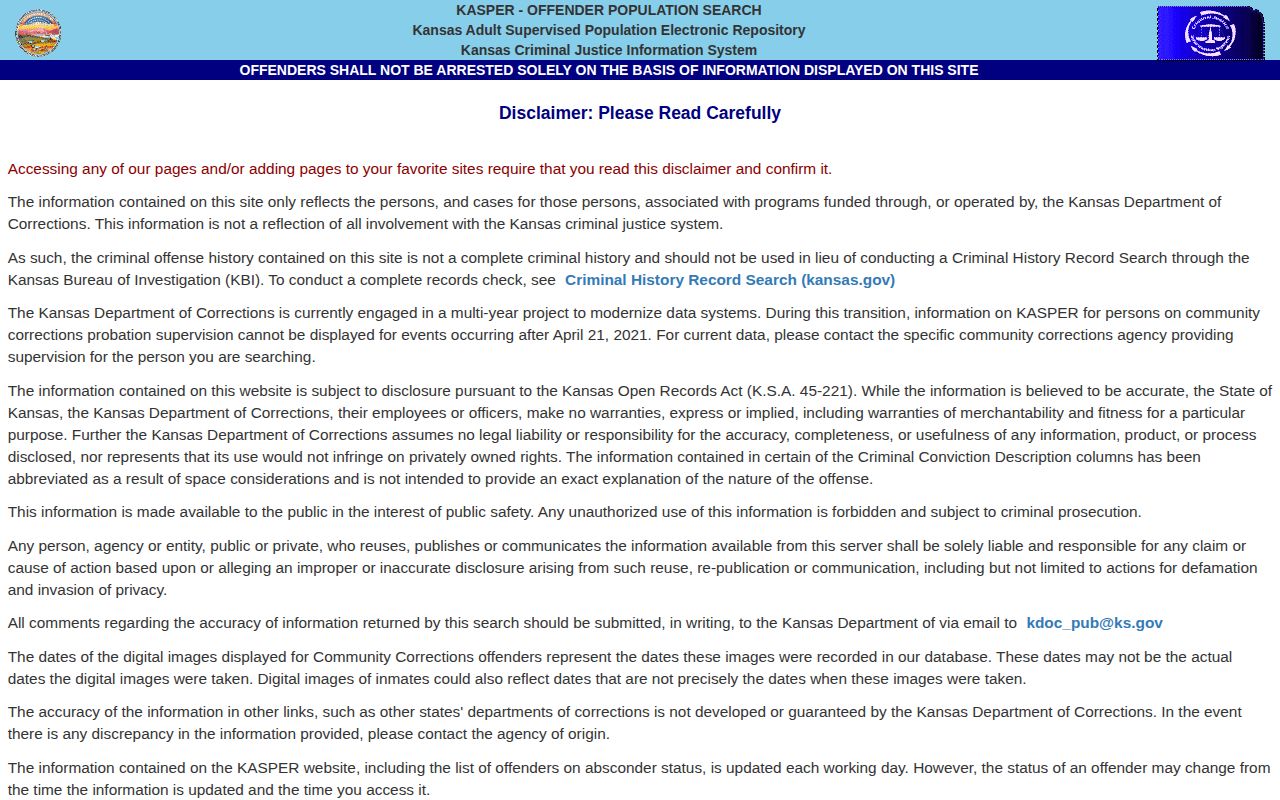
KASPER's disclaimer provides a written correction route at kdoc_pub@ks.gov. A useful message identifies the KDOC number, names the field believed to be wrong, cites the record that supports the correction, and gives safe contact information. The public search is updated each working day, so first distinguish a normal update lag from a durable error.
For an urgent present-status question, contact KDOC or the supervising office as well as sending the correction. A saved result should include the date checked and exact public label. Do not rewrite “Earliest Possible Release Date” as certain, or “Community Corrections” as final discharge. Precise labels allow a later reader to compare the public record after KDOC updates it.
When a Lansing record shows Absconder, KDOC alleges the person stopped complying with required supervision contact. It does not mean discharge and does not authorize public action. Use KDOC's dedicated parole absconder search for that narrow status. If KASPER shows Community Corrections, note its warning that some probation events after April 21, 2021 cannot be displayed and confirm through the local supervising agency.
Search Public Records
Sponsored Results