
Leavenworth County Same-Day Releases
The Leavenworth County Sheriff Released tab is the official starting point for recent county-jail exits. It sorts entries by release time, newest first. The sheriff does not call it a 24-hour list. It publishes no cutoff, refresh rate, item limit, or promise about how long an entry remains. A July 2026 research check found that the visible entries covered more than one day. That dated sample illustrates the problem. It does not create a lasting rule.
Use the posted timestamp, not the page name assumed by a searcher. Subtract the release time from the current time and keep the displayed date and time with the booking number. A new exit may take time to reach the public view. An older item may roll off for reasons the sheriff has not described.
Check Leavenworth 24-Hour Releases
Start at the sheriff roster rather than a copied list. The official roster search offers Current and Released controls. Those controls answer different questions. Current tests whether the person is shown in the jail now. Released displays closed county-jail booking episodes. For a day-based sweep, work from newest to oldest and stop once a displayed timestamp is more than 24 hours old.
- Enter through the sheriff roster and select Released. Confirm that results sort by release time.
- Compare each Release Time with the current time. Do not count by calendar date alone, since midnight splits one rolling day.
- Match the name, age, photograph, and booking number. Similar names can refer to different people or booking episodes.
- Save the exact release timestamp and booking number. Treat charges and bond as booking facts, not as the cause of release.
- Check the Current control for a later booking. A released entry does not rule out return to custody.
- Use VINE, the court file, or the sheriff to verify the event and destination when the distinction matters.
The named-person search and records path on the Leavenworth County released inmates page is more useful when the goal is one person rather than a scan of everyone posted today. It also routes a transfer to the correct state, federal, military, or immigration custodian.
Leavenworth Release List Fields
A released card joins a person to one county-jail booking. The profile supplies more identity detail. Read the fields together and preserve the booking number so that the event can be distinguished from an earlier or later stay.
| Field | What it shows |
|---|---|
| Booking photograph and name | The identity presented for that booking, subject to normal matching care. |
| Booking number | The strongest local key for requesting the same custody episode. |
| Age, gender, and race | Profile details that can help separate people with similar names. |
| Booking date and time | When the displayed county-jail episode began. |
| Release date and time | When the roster records that episode as leaving the county jail. |
| Charges and bond | Booking-related entries, not proof of case outcome or release cause. |
| Arresting agency | The agency tied to the arrest, which may differ from the record custodian. |
No visible field states the release reason, destination, or court outcome. A timestamp beside extradition, transport, a hold, or a sentenced commitment may reflect continued custody elsewhere. The defensible wording is that the sheriff roster “records a release time” for that booking. “Went home” or “case dismissed” requires other evidence.
Note: A bond figure on a released profile does not prove that payment of that bond caused the jail exit.
Leavenworth Bond Release Details
Leavenworth County has a specific bond process. The sheriff detention FAQ places bond transactions in the Bonding Room on the east side of the Justice Center, off Second Street and behind the sally-port circle. Parking is not allowed in the circle. Cash must be exact, and the sheriff links a card-payment option. These details help a person carrying out a bond transaction. They do not explain a roster entry after the fact.
The county justice-system mapping report says First Judicial District Court Services manages pretrial bond supervision. It also says initial appearance is generally within 48 hours, though a Friday or evening weekend booking can take longer. A judge may set cash bail, release on recognizance, or continued detention. Recognizance means release on a promise to return without a cash bond. None of those broad paths lets a reader infer why one posted booking closed.
Match the sheriff timestamp with the court’s bond or release order when bond appears likely. Then ask for the jail disposition field. Physical processing can follow the court order, and another hold can prevent community release even after bond is addressed.
Leavenworth Release Window Limits
The genuine Released tab is useful because it includes photographs and exact times. Its limits are just as important. It promises no fixed 24-hour window. The sheriff also gives no public cadence or retention statement for that display. Online duration is not the legal retention period for the underlying jail record.
A person missing from Released may have an older entry that rolled away, a differently indexed name, a new booking, or a record delay. If the person vanished from Current but never appears on Released, do not report release from absence. Search aliases, inspect VINE, check the court case, and call the jail. A transfer can close the local episode while custody continues.
The wider Jail Releases: 72 Hours method is designed for weekend and multi-day checks, but it uses this same unlabeled source. Neither page can turn the sheriff’s Released tab into a promised window.
Leavenworth Release App Access
The sheriff advertises an official mobile app for iOS and Android. Its public listing supports access to inmate details and booking information. That makes the inmate section a useful secondary route when a phone browser is inconvenient. The listing does not expressly promise the web roster’s Released filter, so an app user should not assume that it contains a complete same-day feed.
The official app page shown below identifies the agency-controlled download route.
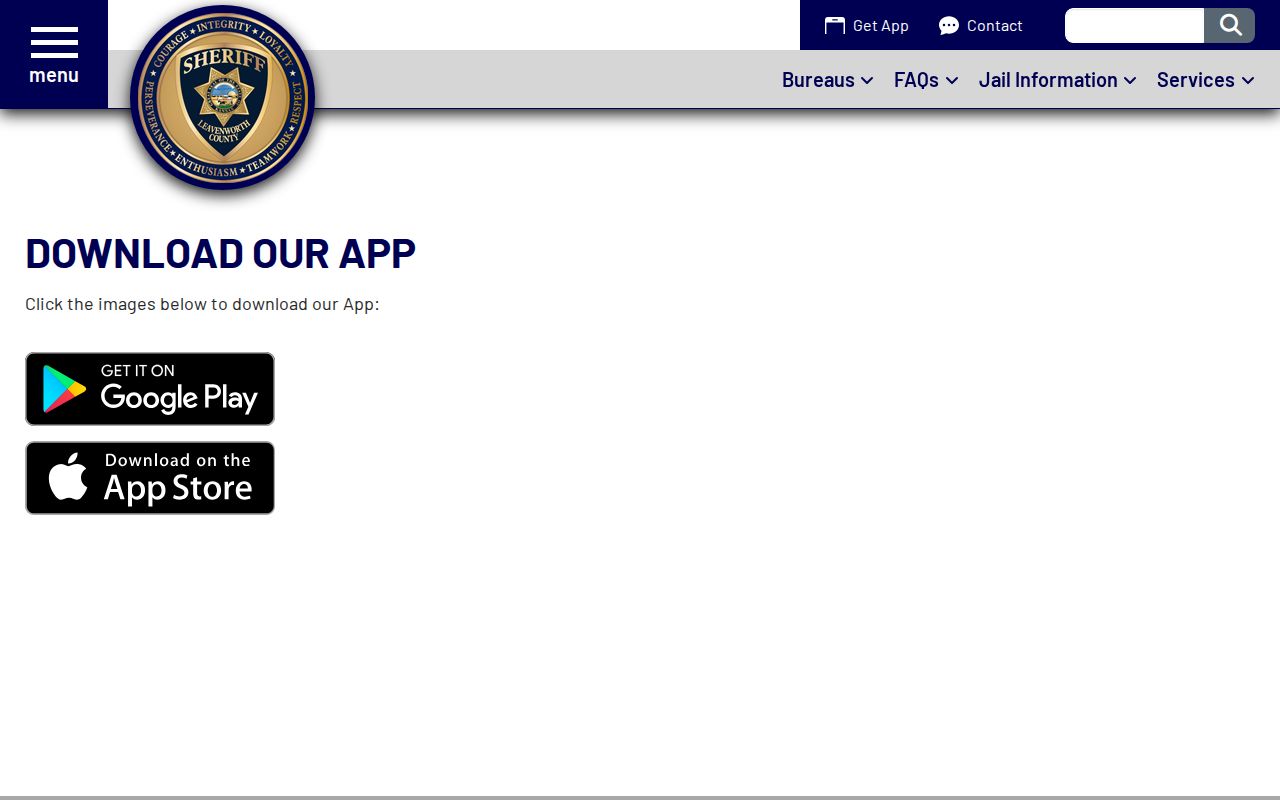
Use the app to inspect an individual booking when available, then return to the sheriff Released tab for the time-sorted web view. A screen capture or app entry is still a public display, not a formal release certificate.
Verify Leavenworth County Releases
The sheriff confirms that jail bookings and releases feed VINE. A VINE alert is strong near-real-time evidence of a Leavenworth County Jail custody change. Preserve the timestamp and identifying booking data. It remains a notification event, not a court ruling. If VINE has no match, call the jail’s 24-hour non-emergency lines at 913-682-5724 or 913-682-1313 to ask whether the person remains there.
For a durable record, use the sheriff open-records form. Identify the full name, approximate booking period, and booking number if known. Ask for the existing booking sheet, custody or release-log entry, release date and time, disposition or type, receiving agency if publicly releasable, and booking photograph. Requesting named existing records is better than asking staff to create a new narrative.
Kansas law requires the office to act on a request by the end of the third business day. Action can mean production, denial, or notice that more time is needed. Reasonable cost estimates and advance payment may apply. A court docket can explain bond, dismissal, sentence, probation, or transfer. Pair it with the jail record because a court order does not establish the exact moment of physical exit.
Leavenworth Release Versus Transfer
Leavenworth County contains county, state, BOP, military, and ICE facilities. The sheriff Released tab covers the county jail. It does not report releases from Lansing Correctional Facility, FCI Leavenworth, the Army correctional facilities, or the Midwest Regional Reception Center. A county-jail transfer to KDOC is found in KASPER. A federal release belongs in the BOP locator. Military custody requires Army confirmation, and immigration detention uses ICE channels.
- Released
- The county roster records that a particular jail episode closed.
- Transferred
- The person left one facility while custody continued under another agency.
- Discharged
- The responsible correctional system records that its sentence or supervision relationship ended.
- Still in custody
- The person remains held by the same or a different custodian.
A VINE release event and sheriff record confirm the local episode. KASPER is only for KDOC-connected cases. The Kansas court case supplies the legal context. The right conclusion depends on which agency controlled the person after the posted time.