
Leavenworth County Release Records
A release record joins a person to the close of one custody episode. At the Leavenworth County Jail, that may be a bond release, recognizance, completion of a county sentence, court order, dismissal, transfer, or pickup by another agency. The sheriff’s live Current roster is designed for people held now. A person normally leaves that view when the local episode closes. That change alone does not show where the person went.
Leavenworth County has an unusually dense correctional landscape. The county jail, a KDOC prison, a BOP institution, two Army correctional facilities, and an ICE contract center sit within the county. Each keeps its own records. A sheriff release time cannot establish a Lansing state-prison discharge, an FCI Leavenworth release, an Army transfer, or an ICE outcome. The source must follow the custodian.
- Release
- Physical exit from a particular jail or prison episode.
- Transfer
- Movement to another facility or agency while custody continues.
- Parole or postrelease
- Release from prison while legal supervision continues.
- Probation
- Court-ordered community supervision, often instead of or after jail.
- Discharge
- The corrections system records that its sentence or supervision relationship ended.
Leavenworth County Release Types
The label matters because release from one place can lead directly into another system. Read the jail disposition, court order, and receiving-agency field together. A charge or bond amount on a Released profile describes the booking but does not prove why the person left.
| Release path | What it means | Where to verify next |
|---|---|---|
| Cash, surety, or recognizance bond | The court allowed pretrial release on stated terms. | Sheriff release entry and district-court bond order. |
| Time served or sentence complete | The local sentence or credited jail term ended. | Journal entry, jail-credit order, and sheriff release time. |
| Dismissal or court order | A judicial action authorized release on that case. | Court docket plus the jail’s physical-exit record. |
| KDOC commitment | The county episode closed through transfer to state custody. | KASPER admission, location, and status. |
| Other-agency pickup | A warrant, hold, extradition, or transport continued custody. | Named receiving agency and transfer record. |
| Parole or postrelease | A state prisoner left prison under supervision. | KASPER and KDOC Parole Services. |
“Time served” means the sentence was satisfied with credit for days already held. “Recognizance” means release on a promise to return without a cash bond. A detainer is authority or a request that keeps custody in place for another matter. Those terms should be used only when the official record supports them.
Leavenworth Release Record Fields
A useful county-jail record ties identity, intake, and exit together. Ask for exact existing fields rather than a new narrative. The online Released profile supplies many booking facts, but it omits release reason, destination, and case outcome. A written request can seek those fields if the jail maintains them and they are publicly releasable.
| Field | What it shows |
|---|---|
| Full name and booking number | The person and unique local custody episode. |
| Booking date and time | When that county-jail episode began. |
| Release date and time | When the sheriff records the episode as closed. |
| Release disposition or type | Bond, sentence completion, court order, transfer, or another recorded path. |
| Destination or receiving agency | Whether custody continued elsewhere, if recorded and releasable. |
| Charges, bond, and arresting agency | Booking context, not final disposition or proof of release cause. |
| Booking photograph | The image associated with that arrest and booking. |
For KDOC, the vocabulary changes to status, admission, convictions, release-related dates, supervision, and Date Discharged when displayed. The BOP locator uses federal identifiers, location or Released status, and a release date. ICE’s locator is mainly a custody locator rather than a lasting discharge certificate. Army confinement requires Army confirmation.
Request Leavenworth Release Records
The sheriff online open-records request is the direct formal route. Written requests can also be delivered or mailed to the sheriff administrative office. A narrow request is easier to locate and less likely to ask staff to create a record that does not exist.
- Give the full name, approximate booking period, and booking number when known.
- Ask for the booking sheet and existing custody or release-log entry.
- Name the release date, time, disposition, and receiving-agency fields sought.
- Request the booking photograph and electronic delivery where available.
- Ask for an estimate and the releasable part if other material must be withheld.
601 S. 3rd Street, Suite 2007
Leavenworth, KS 66048
913-682-5724 or 913-682-1313
Administrative hours: Monday through Friday, 8 a.m. to 5 p.m.
The form lists $5 per case report and $30 per hour for video or audio work, with estimates for media tasks. It does not publish a booking-photo flat fee. The sheriff’s KORA guidance says the office acts within three business days. Action can be production, denial, or notice that more time is needed. Reasonable cost estimates and advance payment are permitted.
The request form shown below is the source for a county release record and booking photograph.
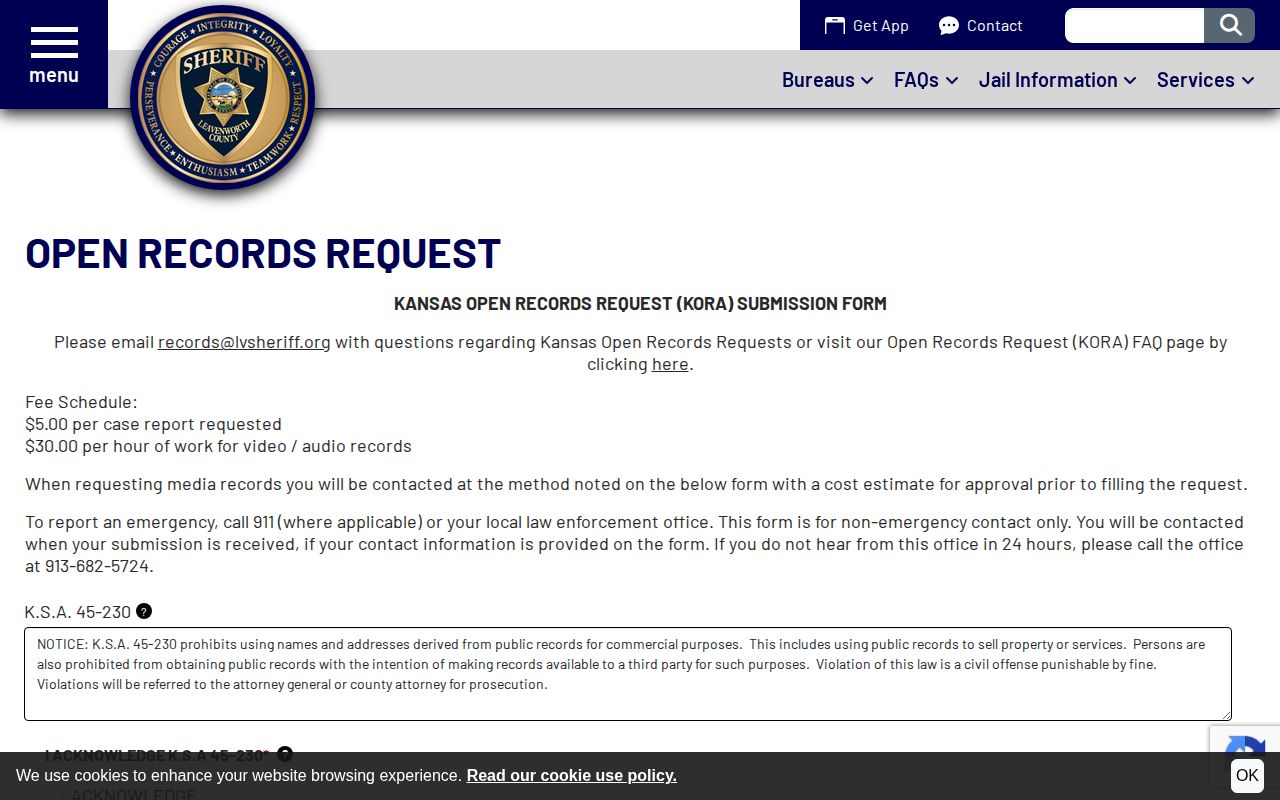
The form is best used for a named booking, not a demand that staff research every possible custody system.
Leavenworth Release Record Laws
Kansas Open Records Act policy favors access unless a law closes the material. K.S.A. 45-217 excludes inmate rosters from the definition of criminal-investigation records. That supports a focused request for an existing jail release entry, though other exemptions and redactions can still apply. K.S.A. 45-218 governs prompt agency action, and K.S.A. 45-219 permits reasonable actual costs.
Juvenile, sealed, expunged, victim, medical, and qualifying investigative material can be restricted. If open and exempt material are mixed, K.S.A. 45-221(d) generally supports separating or redacting the exempt portion. Expungement eligibility under K.S.A. 21-6614 can run from completion or discharge of probation, parole, postrelease supervision, or another sentence component, not merely the jail exit date.
A court expungement changes the rules for public disclosure. It does not turn an earlier jail timestamp into proof that no custody episode occurred, and it does not guarantee removal of every copy held outside government. Arrest-record expungement has separate grounds under K.S.A. 22-2410. When a name or image remains on an official source after an order, send the order to the agency that controls that source. The sheriff controls its booking record, the clerk controls the court file, and KDOC controls KASPER data.
K.S.A. 45-230 also restricts certain commercial uses of lists of names and addresses. Release research should remain focused on custody verification, reconnecting with a person, notification, court process, and obtaining the source record. A request can be denied or redacted under a specific exemption, but the agency should identify the basis and provide any separable open portion.
Note: Online roster duration is not the legal retention period for the underlying Leavenworth County jail record.
Leavenworth County Bond Releases
The sheriff detention FAQ places bond transactions in the Bonding Room on the east side of the Justice Center off Second Street, behind the sally-port circle. Parking is not allowed in the circle. Cash must be exact, and the sheriff links a card option. These directions explain how a bond transaction is handled, not why a displayed Released profile closed.
The county justice-system mapping report says First Judicial District Court Services manages pretrial bond supervision. Initial appearance is generally within 48 hours, with possible delay for a Friday or evening weekend booking. A judge may order cash bail, recognizance release, or continued detention. Another warrant or hold can still prevent community release.
Leavenworth Release Court Records
The Kansas court records guide leads to the district-court public portal. Search by case number when possible and limit by county. Read the register of actions in date order. Bond changes, dismissal, sentencing, jail credit, probation, revocation, and KDOC commitment can explain why custody changed. The court order does not establish the exact physical exit time, so pair it with the sheriff record.
Kansas Supreme Court Rule 22 preserves courthouse-terminal access to some public material not displayed online. Sealed and expunged material remains nonpublic. The Leavenworth District Court records office at 601 S. 3rd Street, Suite 3051 publishes 913-684-0716 for records. Its local records page lists $0.25 per ordinary page, $0.50 per transcript page, $1 per certification, and $20 per hour for extensive staff time.
The Kansas case-search screen shown below is the online court starting point.
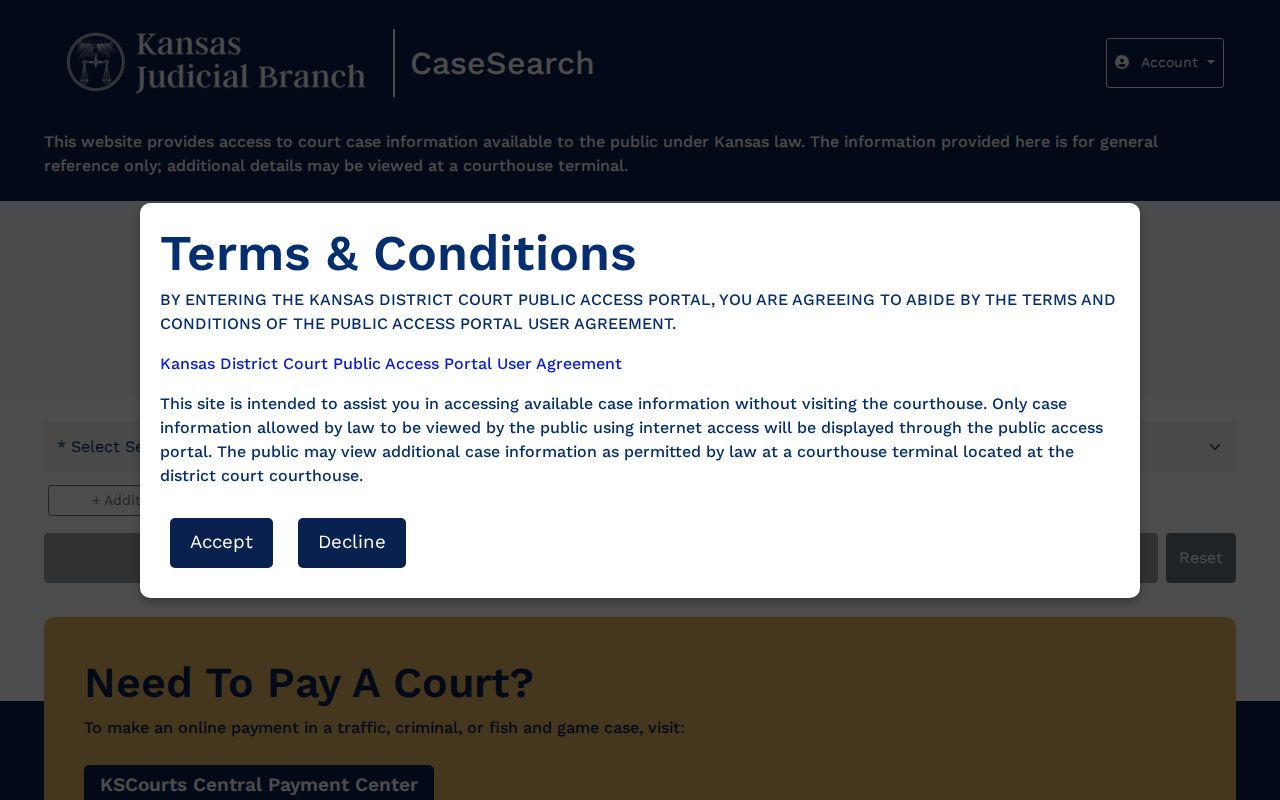
The portal supplies legal context after a short sheriff feed rolls over, while the jail record remains the source for the exit timestamp.
Find Leavenworth County Released Inmates
Start by naming the custodian, then follow the record chain. A person missing from one list may have moved to another system. Search exact identifiers when available, and do not infer release solely from roster absence.
- For a recent county booking, check the sheriff Current and Released controls. Match the booking number and release time.
- Search Kansas VINE for a Leavenworth County Jail event and preserve any delivered release alert.
- Read the Leavenworth district-court case for bond, dismissal, sentence, probation, or commitment.
- If KDOC commitment appears, search KASPER by KDOC number or exact identity.
- For federal, Army, or ICE custody, switch to that agency’s locator or records channel.
- When the online trail ends, request the existing release or transfer entry from the custodian.
The Jail Releases: 24 Hours view supports a same-day scan. It uses the sheriff’s genuine Released tab but does not claim a fixed sheriff window. For a predicted KDOC date rather than a completed event, use the Projected Release route.
Leavenworth KDOC Offender Search
KASPER is the Kansas Adult Supervised Population Electronic Repository. It covers KDOC-associated people and programs, not every county arrest. KDOC says it updates each working day. A late Friday or holiday event may therefore lag. A county bond release will not appear unless the person also entered KDOC custody.
| Search field | How to use it |
|---|---|
| KDOC number | Strongest key for one state-corrections record. |
| First, middle, and last name | Search exact names and include aliases when needed. |
| KBI state ID, birth date, or age | Narrow similar name results. |
| Race, gender, and photo option | Compare identity without relying on one trait. |
| Conviction county | Find the court county, which may differ from current location. |
| Facility or supervision county | Separate current prison location from parole or community supervision. |
| Supervision type | Options include inmate, parole, discharged, absconder, and Community Corrections. |
Open the detail record and transcribe exact fields. “Current Status: Discharged” with “Date Discharged” is stronger evidence that KDOC control ended than absence from a prison list. A parole or postrelease status means the person left prison but remains supervised. KASPER’s Earliest Possible Release Date is predictive and can change.
The KASPER entry shown below begins the KDOC search.
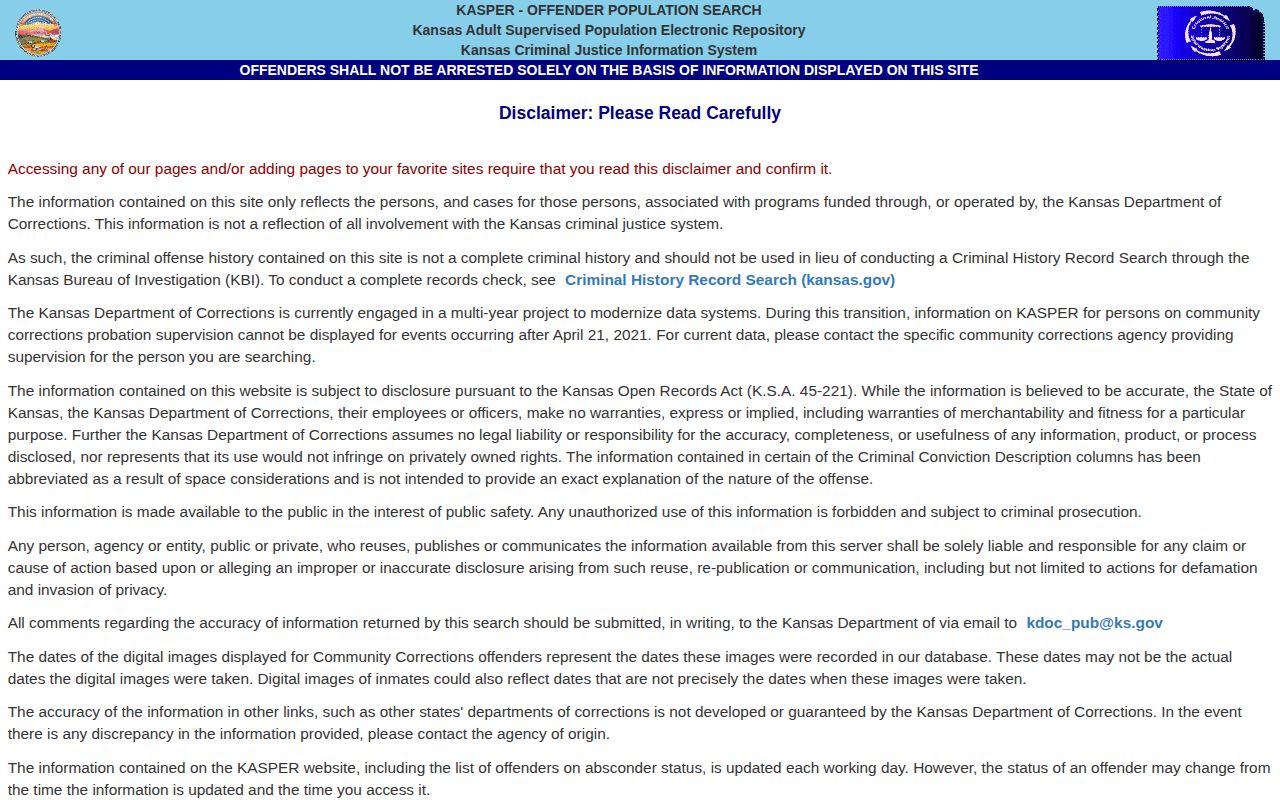
Accept the disclaimer, complete the site check, and use a KDOC number whenever the court or jail record supplies it.
Leavenworth Recent Release Search
The sheriff Released tab sorts by release time and shows the photograph, name, booking number, age, booking and release times, charges, and bond. A profile adds gender, race, and arresting agency. It does not show release reason, destination, or court outcome.
No separate 24-hour or 72-hour sheriff feed was found. The Released tab promises no fixed duration, cadence, or retention period. A July 2026 observation spanned about 35 hours, but that snapshot is not policy. A missing person may have rolled off, been indexed differently, transferred, or belonged to another custodian.
The Released view shown below is the official local feed.
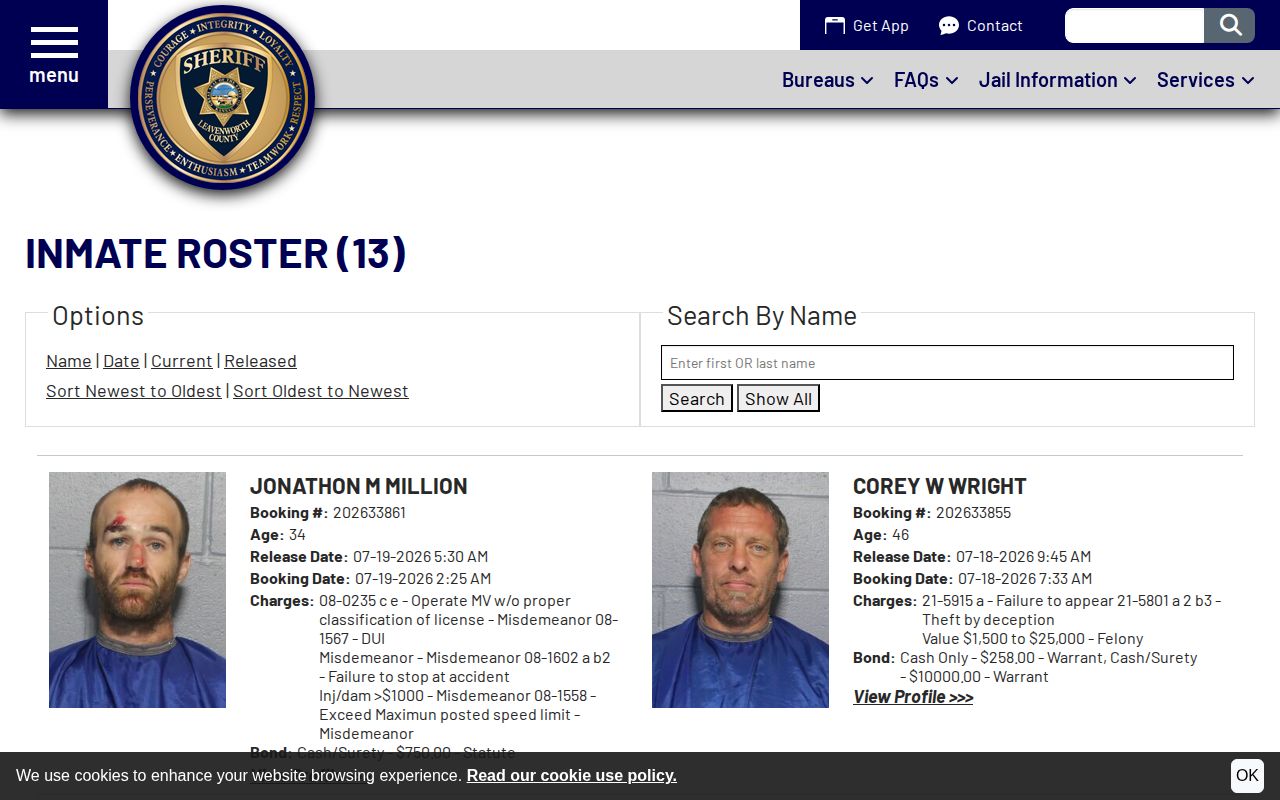
Describe the result as a recorded release time for that booking. Use the jail disposition before saying the person went home.
Leavenworth Release Alerts and Supervision
The sheriff confirms that Leavenworth County Jail bookings and releases feed VINE. Kansas VINE can send email, text, or telephone custody alerts. Kansas courts do not supply court dates or outcomes through it. State guidance also says Kansas VINE covers county jails rather than KDOC prisons. Use KASPER for Lansing Correctional Facility and state supervision.
KDOC Parole Services handles state parole and postrelease supervision. Leavenworth County Community Corrections and First Judicial District Court Services cover distinct county or court-centered supervision. A blank KASPER history cannot disprove Community Corrections supervision because KDOC warns of a display gap after April 2021. Check the sentencing order and local agency.
An absconder status means the supervising agency alleges that the person has stopped complying or reporting. It is not a successful discharge. A person can be outside prison while wanted for a supervision violation. Use the KASPER status and last supervision location, but do not attempt to act on the record. Report urgent information through the responsible agency.
The Kansas VINELink screen shown below supports a specific-person county-jail search.
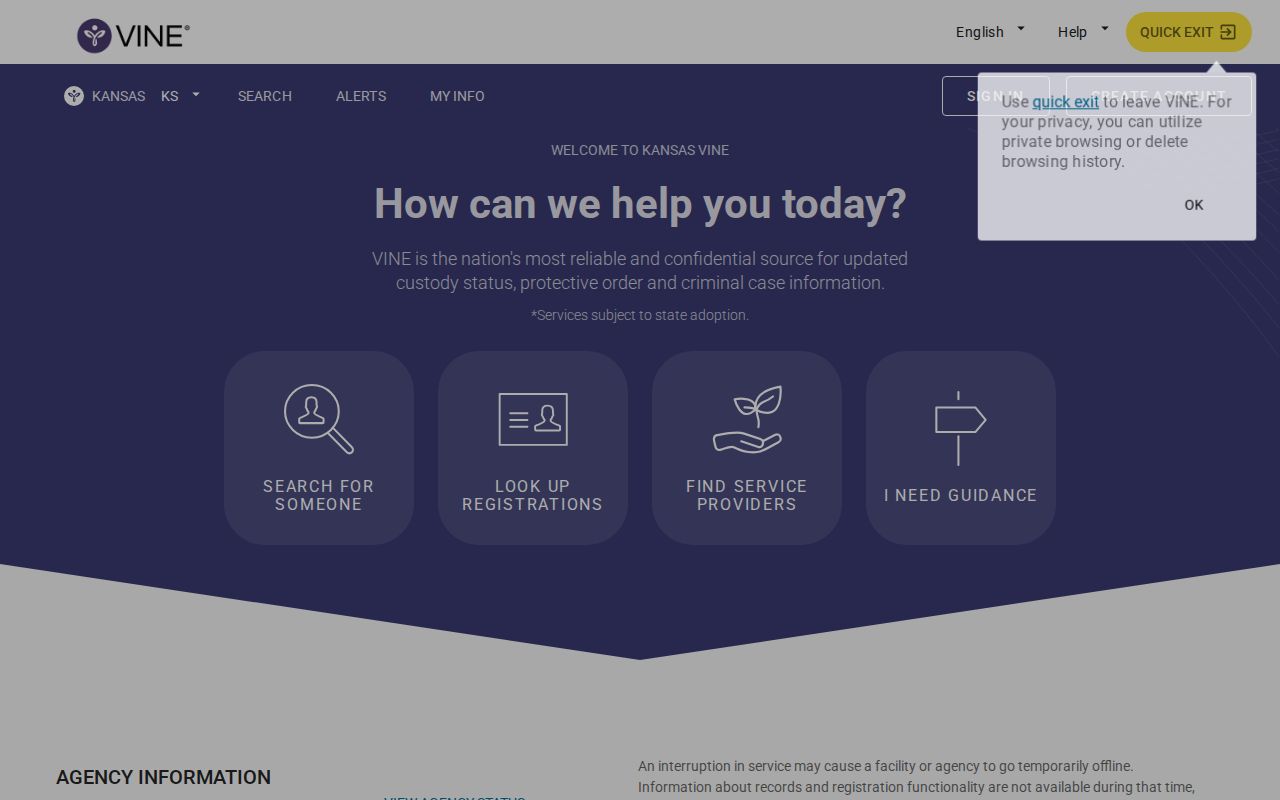
A VINE alert is strong evidence of a custody event, not a judgment or state-prison discharge. The detailed VINELink Inmate Search path covers notification registration.
A registry result is also separate. Kansas registration applies only to qualifying registrants and can remain public long after custody and supervision end. It cannot establish the latest release date. A no-result does not disprove release, conviction, or a duty recorded elsewhere. Use the KBI or sheriff registry only for its statutory purpose and direct corrections to the registering agency.
Leavenworth ICE Release Searches
The former private Leavenworth Detention Center closed under its prior federal mission. CoreCivic announced in March 2026 that the site was reopening as the Midwest Regional Reception Center under an ICE contract. As of July 2026, that change makes the ICE Online Detainee Locator the correct public locator, not the sheriff roster, KASPER, or an old USMS path.
ICE allows search by nine-digit A-number and country of birth or by exact biographical details. Its official scope can include people released from ICE custody in the prior 60 days. No result can also mean transfer, removal, data mismatch, excluded data, or a record beyond that window. Contact Enforcement and Removal Operations when the outcome matters.
Leavenworth Custody Status Sources
The same word, “released,” has different scope in each system. Use the table to select the record before drawing a conclusion.
| System | Still held | Release evidence |
|---|---|---|
| County jail | Sheriff Current roster | Released profile, VINE event, and requested jail entry. |
| KDOC | KASPER inmate status and facility | Parole, postrelease, or Discharged status with exact dates. |
| BOP | BOP locator facility | Released or not-in-BOP-custody result with release date. |
| Army | Army Corrections Command or facility | Army confirmation or responsive military record. |
| ICE | ICE locator and ERO | ICE confirmation distinguishing release, transfer, and removal. |
FCI Leavenworth uses the BOP locator. The United States Disciplinary Barracks and Midwest Joint Regional Correctional Facility are military, not BOP. The registry is a separate statutory record and does not prove a recent release.
Leavenworth County Release Facilities
Custodian identification is the central Leavenworth search skill. The county mapping report documents five correctional systems together, and the 2026 ICE reopening adds the current immigration channel. Each facility page follows its own release path.
- Leavenworth County Jail: confirm community release through VINE and the sheriff record; route transfers to the receiving agency.
- Lansing Correctional Facility: use KASPER and KDOC Parole Services; another KDOC facility is a transfer.
- Federal Correctional Institution Leavenworth: use the BOP locator for Released status and release date.
- United States Disciplinary Barracks: use Army Corrections Command for military custody.
- Midwest Joint Regional Correctional Facility: confirm a military release or transfer through Army channels.
- Midwest Regional Reception Center: use ICE ODLS and ERO to distinguish release, transfer, or removal.
Geography does not determine records custody. Ask which agency held the person, preserve the exact identifier, and use that agency’s terminology.